
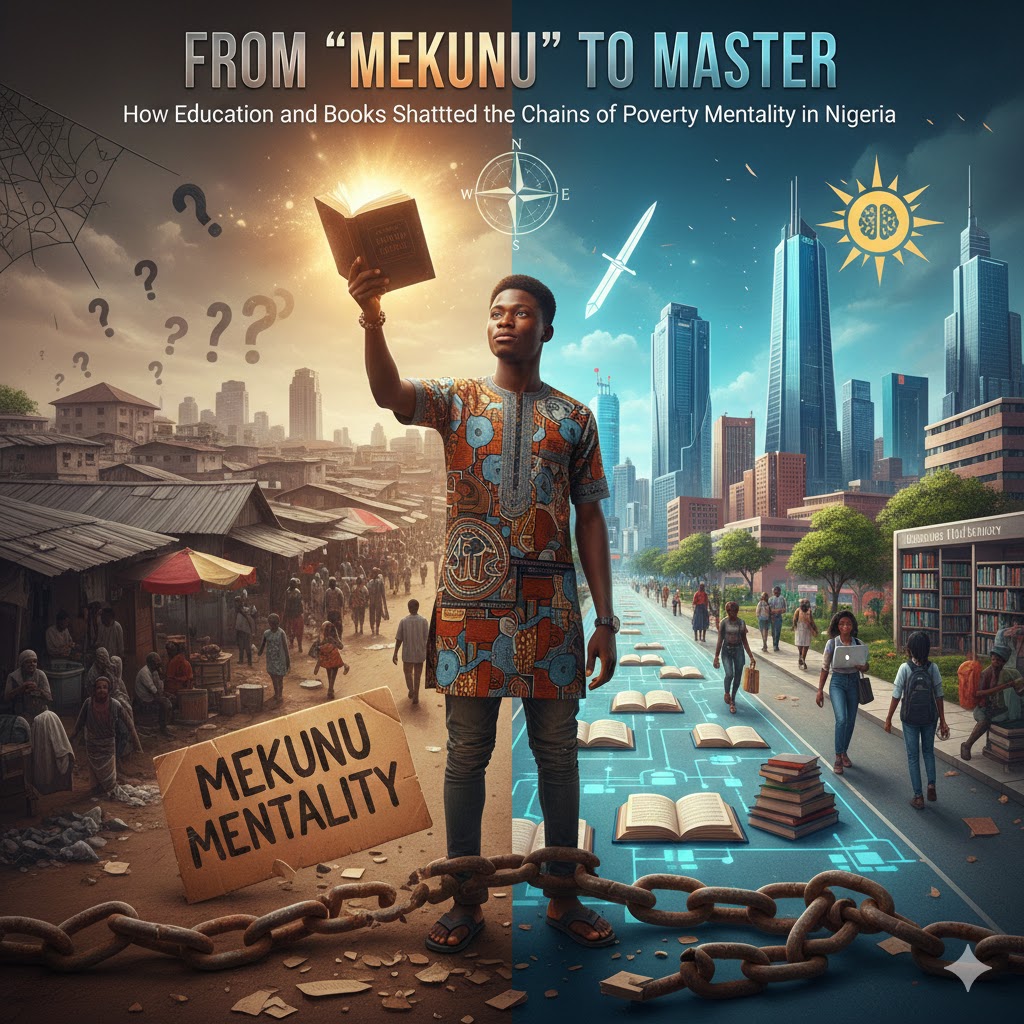
The street hawker in Lagos, the farmer in Kano, the artisan in Port Harcourt—millions across Nigeria toil daily, often trapped in a cycle that extends beyond mere financial scarcity. It’s a profound, insidious force known by many names, but perhaps most starkly as the “Mekunu Mentality.” “Mekunu,” a Yoruba term for ‘the poor’ or ‘the masses,’ implies more than just an empty wallet; it signifies a state of mind—a resignation to fate, a focus solely on immediate survival, and a limiting belief system that suffocates aspiration.
But for many, including myself, there’s a powerful escape route, a liberating force that has proven more potent than any economic stimulus: education and books.
The Invisible Chains: Understanding the “Mekunu Mentality”
Growing up, the “Mekunu Mentality” was an omnipresent force. It manifested as:
- Limited Vision: A world confined to the immediate surroundings, devoid of possibilities beyond the daily hustle.
- Instant Gratification: The desperate need for immediate financial relief, often leading to choices that hinder long-term growth. “Why go to school when I can hawk sachet water now and earn something?”
- Fatalism: The belief that one’s lot in life is pre-ordained, making sustained effort seem futile. “This is just how life is for people like us.”
- Dependency: A reliance on external help or luck rather than internal agency and strategic planning.
- Undervaluing Knowledge: A perceived disconnect between formal learning and practical success, especially in environments where uneducated individuals might achieve material wealth through questionable means.
This mentality, while understandable given harsh realities, becomes the most stubborn barrier to breaking free from poverty. It’s the invisible chain that binds ambition and perpetuates cycles of lack.
The Great Liberators: Education as a Sword, Books as a Compass
My journey out of the “Mekunu Mentality” wasn’t through a sudden windfall, but through the patient, persistent, and transformative power of learning.
1. Education: The Architect of Opportunity
Formal education was the first chisel against the rock of limiting beliefs. It provided:
- Marketable Skills & Credentials: Degrees, diplomas, and technical certifications are not just pieces of paper; they are passports to the formal economy. They equip individuals with the skills needed for better jobs, higher wages, and stable careers—a direct antidote to the hand-to-mouth existence.
- Access & Networks: Education exposes you to new environments, people, and ideas. It builds networks, opens doors to mentorship, and reveals opportunities—from scholarships to entrepreneurial ventures—that remain invisible to the uneducated.
- Critical Thinking: Perhaps most crucially, education teaches how to think, not just what to think. It fosters analytical skills, problem-solving abilities, and the capacity to discern between genuine opportunity and deceptive schemes. This inoculates against the rash decisions often driven by desperation.
2. Books: The Unlocking of the Mind
While formal education laid the groundwork, it was the world unlocked by books that truly shattered the mental barriers. Books became my silent mentors, my global travel guides, and my personal coaches.
- Expanding the Worldview: Each page turned was a journey beyond my immediate struggles. I encountered diverse cultures, groundbreaking ideas, and the life stories of individuals who overcame far greater obstacles. This starkly contrasted the narrow confines of the “Mekunu” mindset, revealing a universe of possibilities.
- The “Mekunu Mentality” whispers, “This is all there is.” Books shout, “Look what else exists! Look what you can become!”
- Cultivating Aspiration: Reading about innovators, leaders, and thinkers instilled a powerful sense of “If they can, why not me?” It replaced resignation with a burning desire to strive for more, to contribute, and to innovate.
- Building Self-Efficacy and Confidence: The sheer act of comprehending complex ideas, absorbing new knowledge, and expanding vocabulary built an inner confidence that transcended my material circumstances. It wasn’t about what I had, but what I knew and what I was capable of.
- Fostering Patience and Long-Term Vision: The commitment required to read extensively, to understand deep concepts, and to absorb wisdom implicitly teaches patience and the value of delayed gratification—a fundamental shift from the immediate-survival focus.
Breaking Free: A Journey of Mind and Matter
My experience is a testament to a universal truth: true liberation from poverty begins in the mind. The journey out of “Mekunu” is not just about accumulating wealth; it’s about transforming one’s perception of self, possibility, and purpose. It’s about exchanging a mindset of scarcity for one of abundance, not just financially, but intellectually and spiritually.
In Nigeria, where challenges are immense, education and literacy are not luxuries; they are fundamental tools for empowerment, resilience, and national development. They are the keys that unlock the doors of opportunity and free us from the insidious grip of the “Mekunu Mentality.”
If you seek to break free, or to help others break free, look no further than the classroom and the library. For within their walls, a new world awaits—a world where every Nigerian, regardless of their background, can become the master of their own destiny.
Leave a Reply